Nearly half of finance and IT executives have made a major decision on bad data in the past year, and most organizations couldn’t pass an AI governance audit tomorrow. Here’s what SAP’s data platform actually changes, and what no platform can do for you.
In brief
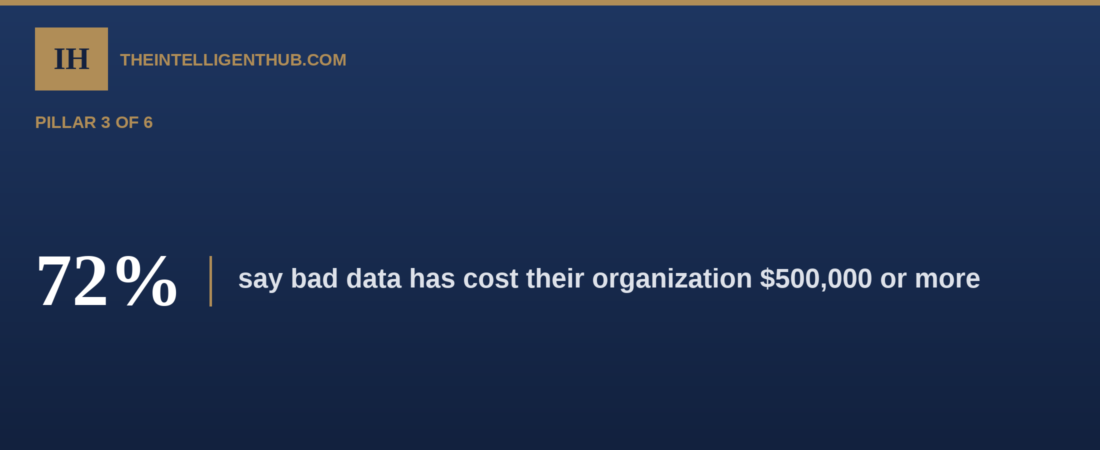
- 47% of finance and IT executives admit they made a major business decision on inaccurate, incomplete, or outdated data in the past year, and 72% say bad data has cost their organization $500,000 or more.
- This is the same root cause the first two articles in this series kept landing on: AI impact stalls on dirty data, and clean core is partly a data governance program wearing an architecture label.
- 78% of business leaders lack strong confidence they could pass an independent AI governance audit within — and organizations with mature governance are roughly four times more likely to report AI-driven revenue growth.
- SAP Business Data Cloud, and its native Databricks integration, is a real answer to the data-fragmentation half of this problem. It is not an answer to the governance and ownership half.
- A four-question readiness check and a maturity model below help you separate the platform decision from the governance decision, because funding one without the other is how this stalls.
The Thread Running Through This Whole Series
Both earlier articles in this series kept arriving at the same root cause from different directions. The AI piece found that 91% of finance organizations adopting AI report only low or moderate impact, and traced a meaningful share of that gap to data quality and master data governance. The clean core piece found that dirty data is, functionally, the data equivalent of a dirty core: duplicate vendor records and inconsistent classifications degrade AI models the same way undocumented Z-programs degrade upgrade reliability.
This article addresses that root cause directly, rather than as a footnote to AI or architecture. The occasion for doing so now is SAP Business Data Cloud, SAP’s answer to enterprise data fragmentation, and the platform every AI agent and every clean-core extension ultimately has to trust if it’s going to work as advertised.
How Bad the Trust Problem Actually Is
It’s tempting to treat “our data isn’t great” as a familiar complaint that every generation of finance leaders has made and every generation has muddled through. The 2026 numbers suggest that framing understates the problem.
A Harris Poll survey conducted on behalf of OneStream in March 2026, polling more than 350 senior finance and IT executives (CFOs, CAOs, CTOs, CIOs, Chief Data Officers, and Chief AI Officers across the US, UK, and France), found that while 96% of executives consider accurate, trusted data very or extremely important to their organization’s success, 47% admit they made a material business decision based on inaccurate, incomplete, or outdated financial data in the past 12 months. Nearly three in four (72%) say bad data cost their organization $500,000 or more, and 37% report losses over $1 million.
The gap between confidence and reality is the more interesting finding. 79% of executives in the same survey believe their data governance can support large-scale AI adoption, and 85% say a formal governance program is in place or underway. But 61% second-guess their own data at least once a month, and 11% question it daily. Only 19% pull the majority of their AI inputs from a single, centralized enterprise system. Most organizations, in other words, believe they’ve solved this, while operating in a way that suggests they haven’t.
There’s also a structural finding worth flagging for anyone who has sat through a CIO-versus-CFO turf discussion: 85% of CIOs in the survey believe they lead data governance, while 78% of CFOs make the same claim about themselves. Both cannot be true, and the survey’s authors found that organizations with genuine Finance-IT alignment are 5.5 times more likely to report complete trust in their data than those without it. The disagreement about who owns governance is not a side issue. It may be the main issue.
The Governance Proof Gap
A separate, larger study reinforces the same pattern from the governance side rather than the data-quality side. Grant Thornton’s 2026 AI Impact Survey, based on 950 C-suite and senior business leaders surveyed between February and March 2026, found that 78% of executives lack strong confidence they could pass an independent AI governance audit. Among organizations still in early piloting, that confidence essentially doesn’t exist: none of the 28 respondents in the earliest adoption stage reported being very confident. Among organizations with fully integrated AI, 74% are very confident.
The performance consequence is stark and directly measured: organizations with fully integrated, well-governed AI are nearly four times more likely to report AI-driven revenue growth than those still piloting, 58% versus 15%. Grant Thornton frames this as a compounding gap rather than a static one: each ungoverned AI initiative makes the next one harder to govern, measure, and defend, because there’s no foundation of trusted data and clear accountability to build on.
One statistic from that same survey deserves particular attention given the previous article in this series: 55% of CIOs and CTOs report that fewer than half of their core applications are AI-ready. That is, in different words, the clean core adoption gap measured from the data-readiness side rather than the code-architecture side. It’s the same problem showing up in a different survey, asked a different way.
The agentic AI numbers in the same report add a sharper edge to the governance picture from the previous article. Nearly three in four organizations are already giving agentic AI access to their data and processes, piloting, scaling, or running it in production, but only 20% have a tested incident response plan for when an agent fails. Most organizations are, for now, keeping the blast radius contained deliberately: only 5% allow agents to execute high-stakes decisions without human review, and 60% cap agents at moderate-risk task automation. But even at those conservative limits, governance hasn’t caught up, and the gap in who’s worried about it is telling: 54% of COOs cite concern about regulatory and compliance uncertainty tied to agentic AI, versus just 20% of CIOs and CTOs. When the people building the systems are less worried than the people who have to answer for what those systems do, that gap is itself a risk indicator worth tracking.
What SAP Business Data Cloud Actually Is
SAP announced SAP Business Data Cloud (SAP BDC) in February 2025 as a fully managed SaaS platform that unifies SAP Datasphere, SAP Analytics Cloud, and SAP Business Warehouse into what SAP calls a single “one domain model,” alongside a landmark partnership bringing Databricks in as a first-party data service inside the platform. The pitch, in SAP’s own framing, is that most organizations don’t have a data volume problem, they have a trust and fragmentation problem: an SAP-commissioned global survey of 1,200 business and technology leaders, cited in SAP’s own launch announcement, found 55% naming poor data quality as their biggest challenge, with harmonizing data across systems cited as a key reason innovation stalls.
Two capabilities matter most for a finance and IT audience specifically. First, SAP Datasphere builds what SAP calls a knowledge graph, preserving the business context and semantics of SAP data (what a cost center actually means, how it relates to a legal entity, which currency conversion rules apply) so that Joule, AI agents, and large language models can reason over the data with that context intact rather than treating it as an anonymous table of numbers. Second, SAP Business Data Cloud Connect to Databricks, which reached general availability in October 2025, enables zero-copy, bidirectional, live data sharing between SAP Business Data Cloud and an existing Databricks lakehouse, built on the open Delta Sharing protocol, with SAP Datasphere governing access and lineage within the SAP perimeter and Databricks Unity Catalog handling permissions and audit logging on the analytics and AI side.
In practice, this addresses a specific, long-standing pain point: organizations have historically blended SAP data with the rest of their enterprise data through fragile methods, custom API exports, object storage copies, manual CSV uploads, each of which introduces governance risk, data silos when pipelines break, and a slow rebuild of business semantics that SAP applications already carry natively. SAP Business Data Cloud’s pitch is that this integration work becomes a configuration exercise rather than a recurring engineering project.
SAP also ships a set of pre-built “insight apps” on top of this foundation, packaged analytics covering working capital, cash flow, and profitability with predefined metrics and AI models already wired in, rather than requiring every customer to build the same finance dashboards from scratch. Henkel’s head of business technology described the appeal in SAP’s own launch materials as the ability to “model scenarios and leverage AI insights” on data that’s already trusted and business-ready, a fair summary of the intended value, worth reading as a vendor-selected customer endorsement rather than independent evidence, but directionally consistent with what the architecture is designed to do.
What It Solves, and What It Doesn’t
It’s worth being precise about the boundary here, because platform announcements tend to blur it. SAP Business Data Cloud is real infrastructure that removes a genuine technical obstacle: the cost and fragility of moving SAP data into the tools where analytics and AI actually happen, while preserving the business context that makes that data useful once it arrives. That is not a small thing, and it directly supports both of the previous articles in this series, cleaner data pipes make AI agents more reliable and reduce one more reason for teams to build custom, non-clean-core workarounds.
What it does not solve is who owns data governance, what “trusted” means for a given data product, or who is accountable when a number turns out to be wrong. Those are exactly the questions the OneStream survey found organizations disagreeing about internally (CIOs and CFOs both claiming ownership) and exactly the questions Grant Thornton found boards approving AI investment without addressing (48% of boards that approved major AI investment have not set AI governance expectations, and 46% have not integrated AI risk into ongoing oversight). No platform migration answers those questions. They get answered by an organization deciding to answer them, with a named owner and a documented process, independent of which vendor’s data platform sits underneath.
This is the same distinction the clean core article made about BTP: side-by-side extensibility without a CCOE just relocates technical debt to a new address. The data-platform equivalent is just as real. A unified data platform without clear ownership and governance discipline doesn’t unify trust, it just gives disconnected, ungoverned data a single, more convincing-looking home.
What This Means for CIOs
For CIOs evaluating or already running SAP Business Data Cloud, five implications follow from the data above:
- Treat the platform migration and the governance program as two separate funding lines: one is infrastructure, the other is organizational discipline. Funding the first without the second produces exactly the pattern Grant Thornton documented: activity without accountability.
- Resolve the CIO-versus-CFO ownership question explicitly, in writing: the OneStream data shows both functions independently believe they lead governance. That ambiguity is tolerable when the stakes are a dashboard nobody trusts. It stops being tolerable once AI agents are posting transactions autonomously, which is exactly the direction both S/4HANA Finance and BTP extensibility are heading.
- Use the knowledge graph as leverage for the clean core conversation, not a substitute for it: SAP Datasphere’s business semantics only stay reliable if the underlying process logic they describe stays close to standard. A knowledge graph built on top of a heavily customized core inherits that core’s inconsistencies; it doesn’t fix them.
- Build (or demand) a tested AI incident response plan before scaling agentic AI further: only one in five organizations in Grant Thornton’s survey has one. This belongs in the same governance conversation as the AI Agent Hub and CCOE structures discussed in the first two articles, not as a separate, lower-priority initiative.
- Pilot with a pre-built insight app before committing to a custom build: SAP’s packaged working-capital and cash-flow insight apps are a lower-risk way to validate whether the underlying data foundation is actually trustworthy before your team invests months building custom analytics on top of it. If the packaged app surfaces obviously wrong numbers, that’s a data-quality signal worth acting on before, not after, a larger investment.
What This Means for CFOs
For CFOs, the OneStream and Grant Thornton data together make a specific, board-ready argument:
- The cost of bad data is already measurable, use it: 72% of peer organizations report losses over $500,000 from bad data, with more than a third over $1 million. This reframes a data governance investment from an abstract IT ask into a documented risk with a dollar figure attached, which is a much easier conversation to have with a board.
- Demand proof, not confidence, before the next AI budget cycle: 78% of executives can’t demonstrate they’d pass a governance audit today. “We’re confident in our data” is not evidence. A documented source of truth, consistent data quality rules, and audit-ready lineage are evidence, and today only about half of organizations have established any of the three consistently, per the OneStream data.
- Settle the ownership question before it becomes a control failure: nearly a third of CFOs in the OneStream survey cite “lack of data ownership” as a key barrier. This is a governance design decision, not a technology purchase, and it’s cheaper to resolve now than after an AI agent makes a material misstatement traceable to ungoverned data.
- Fund Finance-IT alignment as directly as you’d fund any other control: the 5.5x trust differential between aligned and misaligned organizations in the OneStream data is one of the largest effect sizes in this entire research base. Few controls offer that kind of return for what is, in practice, a facilitation and governance-design exercise rather than a large capital investment.
- Ask which specific decisions were made on bad data last year, not just whether it happens: 47% of peer executives admit it happened; far fewer can name which specific forecasts, budgets, or investment decisions were affected. That specificity is what turns a vague governance initiative into a prioritized backlog, the same way a custom code inventory turned clean core from an aspiration into a program in the previous article.
What “Good” Looks Like: A Simple Maturity Model
As with AI adoption and clean core, data trust maturity follows a recognizable pattern, and the OneStream and Grant Thornton data map cleanly onto four stages.
- Stage 1 — Fragmented and unaware: SAP data is blended with other enterprise data through manual exports, CSV uploads, or point-to-point integrations that break silently. Nobody has measured how often decisions rely on data nobody has actually validated. This is the default state for organizations that haven’t yet had a costly incident force the question.
- Stage 2 — Aware but unowned: leadership knows data quality is a problem, probably because something expensive already happened, but no single function has been given clear, accountable ownership of governance. This is where the OneStream survey’s CIO-versus-CFO disagreement lives, and it’s the most common stage among the executives surveyed.
- Stage 3 — Platform in place, governance forming: a unified data platform, whether SAP Business Data Cloud or an equivalent, has consolidated the technical fragmentation, and a governance structure with a named owner is being built on top of it: consistent data quality rules, a documented source of truth, and the beginning of audit-ready lineage.
- Stage 4 — Governed and defensible: the organization can produce, on short notice, a clear account of where a given number came from, who owns it, and what quality checks it passed. This is the small minority (Grant Thornton puts full confidence at this stage around 74%, versus roughly zero at the earliest stage) that captures the 4x revenue-growth differential and the 5.5x trust differential documented above.
Most readers of this article, based on how the survey samples break down, are in Stage 2: aware, motivated, and still missing a named owner. The jump to Stage 3 doesn’t require picking a platform first. It requires picking an owner first, then choosing the platform that owner will be accountable for governing.
Three Objections Worth Taking Seriously
- “Isn’t this just SAP positioning itself against every other data platform vendor?”: Partly, yes, and that’s worth naming plainly. SAP Business Data Cloud competes with building the same capability yourself on a general-purpose lakehouse, and SAP’s launch messaging understandably emphasizes the friction of the alternative. What’s independently verifiable, because it comes from surveys SAP didn’t commission, is that the underlying trust and governance problem is real and severe regardless of which platform you pick. The OneStream and Grant Thornton data would look the same whether or not SAP Business Data Cloud existed.
- “We already have a data warehouse. Isn’t this redundant?”: A data warehouse solves storage and query performance. It doesn’t solve business semantics (what a field actually means in SAP’s process context) or governed, live sharing with the AI and analytics tools your data science team already uses. Those are the two specific gaps SAP Business Data Cloud and its Databricks integration target. If your existing warehouse already solves both, the redundancy argument holds; for most SAP shops, based on the adoption data cited above, it doesn’t yet.
- “Our data team says governance is under control.”: Ask them to walk through the specific evidence: a documented source of truth, consistent data quality rules enforced (not just written down), and lineage that would satisfy an external audit. Per Grant Thornton, 78% of executives overall lack strong confidence they could pass exactly that kind of audit, so “under control” is a claim worth pressure-testing against the evidence, not taking at face value. “Under control” and “defensible on demand” are different claims, and only the second one matters when an AI agent’s output gets questioned.
A Readiness Checklist
Before funding a data platform initiative, or assuming your current governance program already covers it, work through these questions:
- If asked today, could you produce documented lineage for the numbers behind your last board-level AI-informed decision, the way an external audit would require?
- Is there one named function, not two competing ones, accountable for data governance, with the authority to enforce data quality rules rather than just recommend them?
- What share of the AI inputs your organization actually uses come from a single, governed, centralized source, versus ad hoc exports and manual reconciliation?
- Does your data platform decision (SAP Business Data Cloud, Databricks, or otherwise) have a governance workstream funded alongside it, with its own owner and deliverables, or is governance an assumed byproduct of the platform migration?
Why This Ties Directly Back to Clean Core and the 2027 Deadline
Data trust, clean core, and the 2027 migration deadline are not three separate initiatives; they are three views of the same architectural decision. A clean core makes the data flowing through S/4HANA more consistent and trustworthy in the first place. A governed data platform, whether SAP Business Data Cloud or an alternative, carries that trustworthy data out to the AI and analytics tools that need it, with business context intact. And the AI agents covered in the first article only deliver the impact their business case promised when both of those foundations are in place underneath them.
For organizations still planning an S/4HANA migration ahead of the 2027 deadline, this argues for treating the data platform and governance decision as part of the same technical design conversation as clean core, not a follow-on project scheduled for whenever budget allows. For organizations already live on S/4HANA without either in place, the sequencing is the same as it was for clean core: start with an honest inventory of where trust actually breaks down today, assign an owner, and build the governance discipline in parallel with, not after, any platform consolidation.
The Bottom Line
The data in this article, from two independent, methodologically transparent surveys covering more than 1,300 executives combined, points to the same conclusion as the first two articles in this series, arrived at from a third direction: the technology is not the constraint. SAP Business Data Cloud, and platforms like it, genuinely solve the fragmentation half of the data trust problem. They do not solve, and were never going to solve, the governance half, because that half is a decision about ownership and accountability that only the organization itself can make.
The organizations that will show up in next year’s version of these surveys with real confidence, not just stated confidence, are the ones treating data trust, clean core, and AI governance as one coordinated program with named owners at each layer. Everyone else will keep buying platforms to solve a problem that was never primarily about platforms.
Sources
- OneStream (Harris Poll), “Companies Are Scaling AI on Data They Don’t Trust, New Study Finds”, May 5, 2026 — https://www.prnewswire.com/news-releases/companies-are-scaling-ai-on-data-they-dont-trust-new-study-finds-302761641.html
- Grant Thornton, “2026 AI Impact Survey Report: The AI Proof Gap” — https://www.grantthornton.com/services/advisory-services/artificial-intelligence/2026-ai-impact-survey
- SAP News Center, “SAP and Databricks Open a Bold New Era of Data and AI”, Feb 13, 2025 — https://news.sap.com/2025/02/sap-databricks-open-bold-new-era-data-ai/
- Databricks, “Announcing the General Availability of SAP Business Data Cloud Connect to Databricks”, Oct 6, 2025 — https://www.databricks.com/blog/announcing-general-availability-sap-business-data-cloud-connect-databricks
Note: the 55%-poor-data-quality figure cited in the SAP Business Data Cloud launch announcement comes from an SAP-commissioned survey, not an independent source, and is flagged as such in the text. The OneStream and Grant Thornton surveys were independently commissioned (by OneStream and Grant Thornton respectively, via Harris Poll and Grant Thornton’s own research team) and are not SAP-sponsored research.
Related
Want the full picture? Explore the full series →
Evaluating your own SAP transformation program? Explore Advisory →
Have a concrete skills gap on your S/4HANA program? Explore Talent Sourcing →
Get the weekly issue
Join readers getting the next pillar drop straight to their inbox — no spam, unsubscribe anytime.