Embedded AI, agentic automation, and Clean Core are converging in S/4HANA Finance — but adoption is outrunning impact. Here’s what separates the organizations that are actually capturing value from the ones re-running pilots that never scale.
In brief
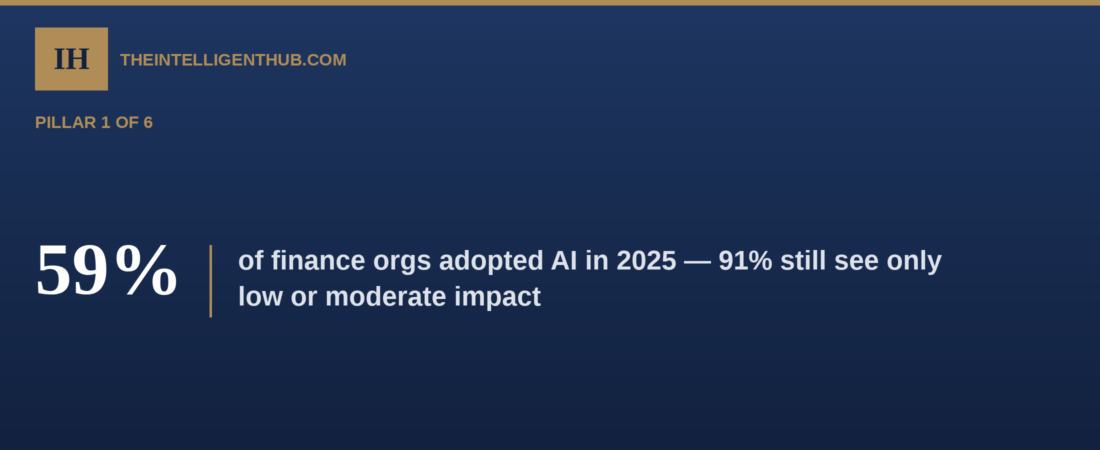
- Finance AI adoption reached 59% in 2025, but 91% of adopters report only low or moderate impact so far — adoption and impact are not the same thing.
- The gap is driven by data quality, core customization (technical debt), and finance talent — not by the underlying AI models.
- SAP’s agentic AI (Joule, the Cash Management Agent, the new SAP AI Agent Hub for governance) targets high-volume, rule-based finance processes first — not judgment-heavy ones.
- Clean Core is the architectural precondition for trustworthy autonomous agents; treat AI readiness as part of your S/4HANA migration, not a Phase 2 add-on.
- A six-question readiness framework and a four-stage maturity model below help you locate where your organization actually stands.
The Optimism Gap
Finance functions have spent years being told that AI would transform the closing, forecasting, and working capital management. The adoption numbers back that up, on the surface: according to Gartner’s 2025 AI in Finance Survey of 183 CFOs and senior finance leaders, 59% of finance functions were using AI in 2025, up from 58% in 2024 and a sharp jump from 37% in 2023.
But look one level deeper and the picture changes. In that same survey, 91% of respondents reported only low or moderate impact from their AI initiatives so far. Organizations further along in adoption were roughly twice as likely to report moderate impact and nearly three times more likely to report high impact — which means the gap between “using AI” and “getting value from AI” is not closing on its own. It is being closed, unevenly, by the organizations that fix something more fundamental than the AI model itself.
For SAP shops specifically, that “something” has a name, and it is rarely the one vendors lead with in a demo: architecture. AI is only as reliable as the data and processes it operates on, and most SAP landscapes were not built with AI consumption in mind. They were built — often over a decade or more — to accommodate whatever business requirement was most urgent at the time, one custom field, one Z-program, one workaround at a time.
This article lays out what “AI in SAP Finance” concretely means in 2026, why the adoption-impact gap exists, and what it actually takes — architecturally and organizationally — to move from pilot to production value.
What “AI in SAP Finance” Actually Means in 2026
SAP’s AI strategy in 2026 centers on Joule, its AI assistant and agent orchestration layer embedded across the cloud portfolio — S/4HANA, SAP BTP, SuccessFactors, Ariba, and Sales and Service Cloud. Recent industry accounts tracking SAP’s release notes put the count at more than 40 purpose-built AI agents and over 2,400 Joule Skills embedded across S/4HANA, Ariba, SuccessFactors, and SAP IBP — treat the exact figures as directionally accurate rather than officially audited, since they come from partner and analyst write-ups rather than a single SAP disclosure. Several of those same analysts frame this as the most significant architectural shift in enterprise ERP since the move to real-time in-memory computing with HANA a decade ago — a bold claim, but one worth taking seriously given how differently agentic AI is meant to operate compared to every previous generation of “automation.”
It helps to separate two generations of capability that often get lumped together under the single label “AI,” because they carry very different risk profiles and very different implementation requirements:
- Embedded predictive and machine learning: features that have existed inside S/4HANA modules for several release cycles — automated invoice matching, cash flow forecasting, demand-sensing, anomaly detection. These are narrow, pattern-recognition tools: they surface a suggestion, a flag, or a forecast, and a human still decides and acts. Reliable, well-understood, and largely uncontroversial from a governance standpoint.
- Agentic AI: the newer layer, where an agent is given a business objective and autonomously plans and executes the sequence of actions needed to achieve it — calling APIs, reading and writing SAP data, triggering workflows, escalating exceptions to a human, and handing off to other agents, without a person scripting each step. This is where the productivity claims get large, and where the governance stakes get large too, because the agent is now acting, not just suggesting.
In Finance specifically, the agentic layer is where the most concrete claims are being made, and it is worth walking through what these agents actually do rather than taking the category label at face value. SAP’s Cash Management Agent reached general availability in the first quarter of 2026; according to Prolifics’ account of the release, it reasons over daily bank statements and automates reconciliation, with reported time savings of up to 80% on manual cash-positioning work — a process that traditionally required a treasury analyst to match statement lines against expected receipts and payments every single business day. Worth flagging: that 80% figure is a partner-reported estimate tied to SAP’s own release messaging, not an independently audited benchmark, so treat it as a directional claim to validate against your own current process and its volumes rather than a guaranteed outcome.
What these examples have in common is instructive: each targets a process that is high-volume, rule-governed, and previously absorbed disproportionate headcount relative to its strategic value. None of them replace judgment-heavy work. That distinction — volume-and-rules versus judgment-and-variability — turns out to be the single best predictor of whether a given finance process is ready for agentic AI today, a point we return to in the readiness framework below.
Gartner’s data on actual use case adoption inside finance functions is a useful reality check against the marketing narrative, and it does not fully match where SAP’s own agent roadmap places its emphasis. Knowledge management — helping teams organize, retrieve, and act on internal information — is the single most common AI use case in finance today at 49% adoption, ahead of accounts payable process automation (37%) and error and anomaly detection (34%). Perhaps more telling: when finance leaders were asked which use case delivered the highest impact, code generation came out on top, by a significant margin — a use case almost nobody puts on the front page of an AI transformation deck, and one that has nothing to do with the close, forecasting, or working capital at all. It shows up disproportionately among technical finance staff building custom reports, reconciliation scripts, and BTP extensions — exactly the people a clean core strategy asks to move their work into a governed extension layer in the first place.
The practical takeaway for anyone building an AI roadmap on top of S/4HANA: do not let the vendor’s product catalog set your sequencing. Match the capability to the process characteristics — volume, rule-clarity, and data quality — and let the evidence on impact, not the demo, decide what gets funded first.
The bigger structural move came at SAP Sapphire 2026 in May, when SAP consolidated SAP BTP, SAP Business Data Cloud, and SAP Business AI into a single SAP Business AI Platform, organized into three layers. A context layer unifies SAP and non-SAP data together with what SAP calls Domain Models — pre-trained models built on SAP’s own code and business logic, designed so an agent can understand SAP-specific concepts, including, per SAP’s own description, posting logic inside SAP S/4HANA Finance, without a developer hand-coding those rules. A build layer, Joule Studio 2.0, gives business analysts a low-code way to specify a business outcome and generate a custom agent pre-loaded with that process context; SAP said it would begin rolling out in June 2026. And a governance layer, SAP AI Agent Hub — built on SAP LeanIX and targeted for general availability in the third quarter of 2026 — is designed to let IT track, verify, and audit every agent running in the landscape, SAP-delivered or custom, against defined policies and KPIs.
For CIOs, this consolidation is a double-edged signal: on one hand, a dedicated governance layer purpose-built for agent oversight is exactly the control point this article has been arguing finance organizations need before scaling autonomous agents; on the other, it means today’s fragmented tooling is, by SAP’s own roadmap, transitional. Any AI governance framework built now should be designed to plug into AI Agent Hub once it reaches general availability, rather than assume today’s ad hoc controls are permanent.
Why Most Pilots Stall Before They Scale
If the technology is this capable, why does Gartner still find 91% of adopters stuck at low or moderate impact? Three structural obstacles show up consistently across the survey data and across what practitioners see in the field, and all three are addressable — just not with more AI licenses.
The first is data. Gartner identifies data literacy and technical skills, along with inadequate data quality and availability, as the largest obstacles to AI adoption across all organizations surveyed, finance included. An agent that reasons over bank statements or intercompany postings is only as trustworthy as the master data and transactional history it reads. Years of inconsistent cost-center logic, duplicate vendor records, or undocumented manual journal entries do not disappear because an AI agent has been switched on — they become the exact inputs the agent has to reason around, badly. Worse, an agent that is uncertain will often produce a confident-looking output anyway, which means bad data does not fail loudly; it fails quietly, as a plausible-looking accrual or reconciliation that is simply wrong.
The second is architecture, and this is where SAP shops carry a specific, well-known liability: technical debt accumulated through years of core customization. Custom fields bolted directly onto standard tables, business logic buried in Z-programs, and modifications to standard code paths all create a moving target that AI agents cannot reliably navigate, because the “standard” behavior they were trained and configured against no longer matches what the system actually does in your landscape. An agent designed to resolve a posting error by referencing standard SAP logic will misdiagnose — or simply refuse to act on — an error rooted in a custom validation rule nobody documented in 2014.
This is precisely the problem SAP’s Clean Core strategy — moving custom logic to a governed extension layer on BTP instead of inside the core — was designed to solve, and it is the subject of a next article of the series. The short version: a landscape that is not clean core is a landscape where AI agents cannot be trusted to act autonomously, no matter how good the underlying model is.
The third obstacle is organizational rather than technical, and it is easy to underweight: talent. A Gartner survey of 100 CFOs conducted in January and February 2026 found that acquiring and developing AI and digital talent inside the finance function is now CFOs’ top near-term challenge — ahead of budget, ahead of technology selection, ahead of vendor risk. Buying the software was never the hard part. Building a finance team that can validate an agent’s output, know when to override it, and redesign a process around what the agent is actually good at requires a different skill set than the one most finance organizations hired for over the last decade.
These three obstacles compound each other in a specific, predictable sequence that shows up in almost every stalled AI program: poor data quality produces unreliable agent output; unreliable output erodes trust faster than it was built; eroded trust causes finance leaders to add manual review steps back into the “automated” process; and the manual review steps consume the time savings the business case promised in the first place. Breaking that cycle requires fixing the data and architecture problem before scaling the agent footprint — not in parallel, and not afterward.
What This Means for CIOs
For CIOs sponsoring or governing AI investment inside S/4HANA, five implications follow directly from the data above, and they are listed roughly in the order they should be tackled:
- Sequence architecture before automation: run a clean core readiness assessment before scaling agentic AI beyond a pilot. Every custom object, modified standard table, and undocumented Z-program is a place an AI agent can reason incorrectly with high confidence — which is more dangerous than an agent that simply fails, because a confident wrong answer gets acted on before anyone questions it.
- Build governance for autonomous action: agents that post accruals, resolve reconciliations, or trigger workflows without a human in the loop change your control environment. Define explicitly what an agent may do unsupervised, what requires human approval, and how every autonomous action is logged for audit — before go-live, not after an incident. This governance layer is not optional overhead; it is what makes autonomous agents auditable at all.
- Treat data quality as an IT-owned KPI: not a finance-side complaint to be managed around. If master data governance sits outside your accountability, the AI program you are sponsoring will underperform for reasons that will not be attributed to IT, but that only IT can fix. Put master data completeness and consistency on the same dashboard as system uptime.
- Sequence by AI-readiness, not by hype: well-structured, high-volume, rule-based processes — invoice matching, cash application, accrual estimation — are ready for agentic automation today. Judgment-heavy processes with high variability, like complex disputes or non-standard FP&A scenario planning, are not, regardless of what a vendor demo suggests.
- Instrument before you automate: you cannot prove an agent improved a process if you never measured the process. Before deploying an agent into a workflow, capture baseline cycle time, error rate, and exception volume for at least one full close cycle — this becomes the evidence base for the next funding round.
What This Means for CFOs
For CFOs setting the AI agenda and defending its budget to the board, the data suggests four disciplines that separate the organizations moving toward Gartner’s “high impact” tier from those stuck re-running pilots:
- Set expectations against the real baseline: with 91% of adopters reporting only low or moderate impact initially, a first-year AI pilot that does not transform the close is not a failure signal — it is the norm. The board conversation should be about trajectory and the conditions for scaling, not a single quarter’s ROI.
- Fund for feasibility and impact, not visibility: the highest-impact use case in Gartner’s data — code generation — is one of the least visible to a CFO’s day-to-day. Meanwhile accounts payable automation, the most visible and most commonly funded use case, ranks lower on reported impact. Prioritize the portfolio on evidence, not on what is easiest to put in a steering-committee slide.
- Own the talent and control-environment build-out: the finance team’s data literacy is now a bigger constraint than the AI product itself, per Gartner’s early-2026 CFO survey. And once agents can post transactions autonomously, your internal control framework and audit approach need updating in parallel — this is a finance-function responsibility, not something to delegate entirely to IT or an SI partner.
- Renegotiate the business case honestly: if your original AI business case assumed immediate double-digit FTE reduction, revisit it. The realistic near-term value in most first-generation deployments is cycle-time compression and error reduction, which show up as capacity freed for higher-value work — not as an immediate headcount line item. Overselling the business case up front is the single fastest way to lose board confidence in AI investment for the next three years.
What “Good” Looks Like: A Simple Maturity Model
Across the S/4HANA programs that manage to convert AI pilots into sustained impact, a recognizable pattern of maturity shows up. It is not about how many agents are deployed — it is about whether the foundation underneath them is solid enough to trust.
- Stage 1 — Exploratory: one or two narrow pilots (often invoice matching or a Joule chat assistant), run in a sandbox or non-critical process, with no formal governance for autonomous action yet. Most organizations in Gartner’s 37%-to-58% adoption growth wave over 2023–2024 entered here.
- Stage 2 — Piloted but stalled: AI is live in production for a handful of use cases, but impact is low-to-moderate, data quality issues surface regularly, and the team has quietly added manual review steps back in. This is where Gartner’s 91% currently sit — the largest group by far.
- Stage 3 — Architecturally ready: a clean core assessment has been completed, custom logic is being migrated to BTP extensions, master data ownership is assigned, and a governance framework for autonomous agent actions exists and is enforced. Impact is starting to compound because the foundation no longer fights the AI layer.
- Stage 4 — Scaling with evidence: multiple finance processes run on agentic AI with documented before/after baselines, the finance team has a data literacy program in place, and use case selection is driven by a feasibility-and-impact scorecard rather than by vendor roadmap. This is Gartner’s high-impact tier, and it is a small minority today — which is exactly why it is a source of competitive advantage for whoever gets there first.
Most organizations reading this sit somewhere between Stage 1 and Stage 2. The jump to Stage 3 is rarely a technology purchase — it is a deliberate, funded architecture and governance workstream, usually run in parallel with (or just ahead of) a broader S/4HANA clean core initiative.
Three Objections Worth Taking Seriously
Before moving to the readiness framework, three objections come up often enough in steering committee conversations that they deserve a direct answer rather than being waved away.
- “Isn’t this just SAP marketing repackaged as thought leadership?”: A fair challenge, and one worth applying to any vendor-adjacent AI content, including this article. The distinction worth drawing is between SAP’s product claims — which should always be treated as best-case, vendor-reported figures until validated in your own landscape — and the independent Gartner survey data on adoption and impact, which comes from CFOs, not from SAP. The 91%-low-or-moderate-impact figure is not a number SAP would choose to publish; it is the honest baseline against which any vendor’s ROI claim should be tested.
- “We already tried AI and it didn’t deliver — why would this time be different?”: Usually because the first attempt targeted a visible, high-profile process rather than a high-feasibility one, skipped the data quality work, or launched without a governance model for what the agent was allowed to do autonomously. Gartner’s own data shows organizations further along the maturity curve are three times more likely to report high impact — the technology did not fundamentally change between your first attempt and now; the surrounding conditions are what determine the outcome.
- “Does this mean agentic AI is coming for finance headcount?”: In the near term, the evidence points toward capacity redeployment rather than mass reduction: the agents in production today absorb the highest-volume, lowest-judgment tasks — reconciliation matching, accrual estimation, cash positioning — freeing analysts for exception handling, variance analysis, and business partnering that agents are not close to being trusted with. That said, CFOs should plan workforce strategy honestly around this shift rather than avoid the conversation: the skill mix finance needs in three years — more data literacy, more agent-output validation, less manual transaction processing — is different from the skill mix most finance teams have today, and that transition needs active management, not denial.
A Practical Readiness Framework
Before funding the next phase of AI investment in your S/4HANA landscape, work through these six questions with IT and Finance in the same room:
- Is your core clean enough that an AI agent can trust what it reads? If you cannot answer this with evidence, start with a clean core assessment, not an AI pilot.
- Which finance processes are rule-based and high-volume, and which are judgment-heavy and variable? Sequence agentic AI accordingly — do not start with your hardest process.
- Who owns the approval and audit trail when an agent posts or changes something autonomously? If the answer is unclear, your control environment is not ready for production agentic AI.
- Have you captured a baseline of cycle times, error rates, and cost per transaction before deployment? Without a baseline, you cannot prove impact later — and you will need to, at the next budget cycle.
- Does your finance team have a data literacy plan, not just a tool rollout plan? The Gartner data is explicit: talent, not technology, is the near-term bottleneck.
- Is your 2027 S/4HANA migration roadmap sequenced to enable AI, or is AI being bolted on after the fact? Programs that treat clean core and AI readiness as a single workstream consistently outperform those that treat them as separate initiatives.
Why This Is More Urgent Than It Looks
None of this is happening in a vacuum. Industry surveys tracking enterprise SAP priorities for 2026 report that a large share of enterprise leaders — some figures put it above 40% — now say they prioritize SAP’s AI-driven innovation roadmap over the long-discussed 2027 mainstream maintenance deadline for SAP ECC. In practice, that means the migration conversation and the AI conversation have merged for most organizations still running legacy SAP: the business case for moving to S/4HANA is no longer just “stay supported,” it is increasingly “get on a platform where AI agents actually work.”
That merger has a direct implication for sequencing. If your organization is still planning or mid-way through an S/4HANA migration, the clean core and AI-readiness work described in this article should not be scheduled as a Phase 2 initiative to be revisited after go-live. It belongs inside the migration program itself — in the technical design, the data migration and cleansing workstream, and the extensibility governance model — because retrofitting clean core into a landscape that has already gone live with fresh customizations is a materially harder, more expensive exercise than building it in from the start. We cover this migration sequencing question in detail in a later article in this series; for now, the operating principle is simple: treat AI readiness as a migration requirement, not a post-migration nice-to-have.
The Bottom Line
The gap between AI adoption and AI impact in SAP Finance is not, fundamentally, a model quality problem — the agents SAP ships today are genuinely capable within well-defined scopes. It is an architecture and governance problem, and it is solvable with the same discipline that has always separated successful SAP programs from stalled ones: clean data, clean core, clear ownership, and a realistic sequencing plan.
Organizations that treat clean core and AI readiness as one workstream, fund based on evidence rather than visibility, and build the governance for autonomous agents before they go live are the ones who will show up in next year’s Gartner survey in the high-impact tier. Everyone else will still be running pilots, funding them one budget cycle at a time, and wondering why the productivity gains never quite show up on the P&L.
The organizations that get this right over the next 18 months will not have done so because they had access to better AI models — everyone is drawing from largely the same underlying technology. They will have done so because they treated the unglamorous, unglossy parts of the problem — data governance, clean core, sequencing discipline, talent development — as the actual project, with AI as the payoff rather than the starting point.
Sources
- Gartner, “Gartner Survey Shows Finance AI Adoption Remains Steady in 2025,” Nov 18, 2025 — https://www.gartner.com/en/newsroom/press-releases/2025-11-18-gartner-survey-shows-finance-ai-adoption-remains-steady-in-2025
- Gartner, “Gartner Survey Reveals Acquiring and Developing AI and Digital Talent is CFOs’ Top Near-Term Challenge,” Mar 23, 2026 — https://www.gartner.com/en/newsroom/press-releases/2026-03-23-gartner-survey-reveals-acquiring-and-developing-ai-and-digital-talent-is-cfos-top-near-term-challenge
- Prolifics, “SAP Joule Agentic AI 2026: Moving Beyond Simple Chatbots to Autonomous ERP” — https://prolifics.com/usa/resource-center/blog/sap-joule-agentic-ai
- ERP Today, “SAP Sapphire 2026: SAP Business AI Platform Consolidates SAP BTP Stack to Solve Enterprise AI Fragmentation” — https://erp.today/sap-business-ai-platform-consolidates-sap-btp-stack-to-solve-enterprise-ai-fragmentation/
- Kagool, “SAP S/4HANA Finance Transformation: A Strategic Guide for Enterprise Leaders in 2026” — https://kagool.com/sap-s-4hana-finance-transformation-a-strategic-guide-for-enterprise-leaders-in-2026/
Related
Want the full picture? Explore the full series →
Evaluating your own SAP transformation program? Explore Advisory →
Have a concrete skills gap on your S/4HANA program? Explore Talent Sourcing →
Get the weekly issue
Join readers getting the next pillar drop straight to their inbox — no spam, unsubscribe anytime.