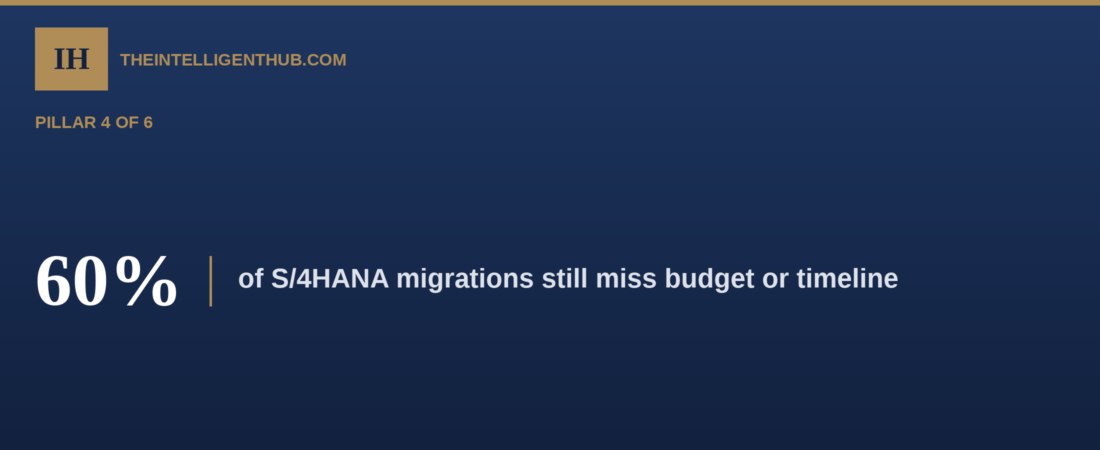
AI has overtaken the 2027 deadline as the top reason to migrate, according to new benchmark research. But nearly 60% of migrations still blow their budget and timeline. Here is how the AI, clean core, and data foundations from this series turn into a roadmap a board would approve.
In brief
- For the first time, 43% of organizations cite SAP’s AI announcements, not the 2027 support deadline (39%), as the primary external factor shaping their ERP strategy — SAPinsider’s 2026 ERP Migration and Transformation Benchmark Report.
- Execution hasn’t caught up with that ambition: 55% of organizations say they’ve deployed S/4HANA, but only 34% have fully completed the transition, per the same report.
- Independent research from ISG, surveying 200 senior decision-makers at large global companies, found nearly 60% of SAP migration projects are delayed and over budget, and fewer than one in five organizations reimplement standard processes rather than carry legacy customization forward.
- As of the end of 2024, roughly 39% of SAP ECC customers had licensed S/4HANA, leaving well over half the installed base still to move before mainstream ECC support ends in December 2027.
- This article closes the series: it takes the AI opportunity (Pillar 1), the clean core architecture decision (Pillar 2), and the data trust foundation (Pillar 3), and turns them into the roadmap, budget line items, and risk contingencies a board would approve.
The Driver Has Changed. The Execution Problem Hasn’t.
For most of the past decade, the argument for moving off SAP ECC was almost entirely defensive: mainstream support ends in December 2027, extended support carries a premium, and the technology underneath finance, supply chain, and HR data would eventually become unsupported and unpatched. That argument still holds. But it is no longer the main one boards are hearing.
SAPinsider’s 2026 ERP Migration and Transformation Benchmark Report, based on a survey of the SAP community conducted between December 2025 and March 2026, found that 43% of organizations now cite SAP’s AI announcements as the primary external factor affecting their ERP strategy, ahead of the 2027 deadline itself, which ranked second at 39%. “The data from our survey of SAP community members paints a picture of organizations balancing the need to update their ERP systems, finding the fastest way of doing that, and also accelerating ways of integrating the promise of generative AI,” says Robert Holland, SAPinsider’s Chief Research Officer.
This is a meaningful shift, and it raises the bar for what a migration business case needs to prove. A compliance-driven case only has to justify the cost of staying supported. A value-driven case, built around the AI agents covered in the first article of this series, has to demonstrate that the platform will deliver the operational impact the board is now being asked to fund it for. That is a higher standard, and the data below suggests most organizations are not yet meeting it.
The Completion Gap: “Deployed” Is Not “Done”
The same SAPinsider report surfaces a gap that should concern anyone building a board narrative around migration progress. On paper, adoption looks strong: 55% of respondents say they have deployed SAP S/4HANA or SAP S/4HANA Cloud over the past year. But only 34% report having fully transitioned. The difference between those two numbers is, in practice, a large population of organizations running legacy and new systems in parallel indefinitely.
SAPinsider’s own guidance to its members is blunt about the cost of that state: running parallel legacy systems drains IT budget, introduces security vulnerabilities, and dilutes the performance benefits the new platform was bought to deliver. Their recommendation is to enforce a strict sunsetting schedule for legacy instances and treat go-live as the start of the transition, not its finish line.
This matters directly for the AI and data arguments made earlier in this series. An AI agent’s business case, and a data platform’s business case, both assume the organization is operating primarily on the new environment. A board that approved an AI-driven S/4HANA investment on the strength of Pillar 1’s numbers is not actually capturing that value while a meaningful share of transactions and reporting still run through the legacy system it was meant to replace.
Why Roadmaps Blow Their Budgets and Timelines
Independent research helps separate vendor optimism from operational reality here. ISG, surveying 200 senior decision-makers at large global companies, found that nearly 60% of SAP migration projects are delayed and over budget. Michael Dornan, ISG principal analyst, attributes much of this to how organizations plan, not to the technology itself: “Some of them are trying to do this quickly, a lift-and-shift as fast and cheap as possible. This group often underestimated the complexity, scope and the constraints they have. They also suffer from scope creep and changing requirements as they go through. A lot of the delays are caused by people, not necessarily the technology.”
The same research found that more than half of respondents agreed they had over-customized their legacy ERP to the point that standardization now feels risky to the business. Dornan’s explanation of that inertia is worth quoting directly, because it is a pattern every CIO reading this will recognize: “There are a lot of stakeholders in the business that actually felt that their old ERP was doing the job that they wanted, which creates inertia.”
The pathway choices in the ISG survey make the stakes concrete. 34% of organizations are opting for brownfield migrations (converting the existing ECC system in place, technical debt and all), 18% are choosing greenfield (a clean, standardized rebuild), and the remaining share, roughly half, are mixing the two in a bluefield approach. Fewer than one in five organizations, in other words, are reimplementing standard processes when they move. The rest are carrying forward exactly the customization and complexity that Pillar 2 of this series identified as the thing clean core is designed to eliminate. ISG’s report notes plainly that brownfield and hybrid approaches can limit long-term benefits and make it harder to adopt newer technologies such as AI, which is precisely the trade-off a board business case needs to make explicit rather than inherit by default.
Choosing the Migration Pathway, and What It Costs You Later
The three pathways are worth defining precisely, because the business case should treat the choice between them as a deliberate, documented decision rather than a byproduct of how much time is left on the clock.
- Greenfield (new implementation): a fresh S/4HANA build on standardized, SAP best-practice processes, eliminating legacy customization. This produces the cleanest long-term outcome and the strongest foundation for the clean core, AI, and data trust work covered earlier in this series, but it requires the most business change management and process redesign effort.
- Brownfield (system conversion): converting the existing ECC system to S/4HANA in place, preserving historical data, configurations, and custom code. Faster and lower-risk in the short term, but it carries forward the technical debt and process complexity the earlier pillars describe as the source of AI adoption gaps and clean core violations.
- Bluefield (selective approach): a hybrid that selectively migrates data into a new S/4HANA system, combining some of greenfield’s process standardization with selective retention of historical configurations. This is where roughly half of organizations in the ISG survey are landing, and it requires the same explicit trade-off documentation as the other two paths.
SAP introduced an Extensibility Rating Model in August 2025 that gives migration teams a structured, A-to-D framework for classifying existing custom code: A-rated extensions can remain in the S/4HANA core, B-rated patterns should be redesigned on BTP, and C or D-rated modifications must be moved to BTP or retired. Running this classification before scoping a migration is now considered a prerequisite for accurate budgeting, and for good reason: organizations that skip it routinely discover mid-programme that their custom code volume is 30 to 50% larger than originally estimated, according to SAP migration practitioners at SAVIC Technologies. That is a direct, quantifiable link between skipping a scoping step and the kind of budget overrun ISG’s independent research documents.
The Clock: Timelines, the Talent Market, and the 2027 Deadline
The scheduling math is unforgiving for organizations that haven’t started. A typical mid-market S/4HANA migration takes 18 to 24 months end-to-end; a complex, multi-country enterprise migration with significant custom code runs 30 to 42 months. An organization starting its programme after mid-2026 has fewer than 18 months left before the December 2027 deadline, which means an accelerated scope, an extended-maintenance parallel run, or a missed cutoff.
As of the end of 2024, Gartner and CIO research cited by SAP migration specialists put the share of ECC customers who had licensed S/4HANA at roughly 39%, meaning well over half of the installed base had not yet secured the platform they need to run after 2027. SAP’s official extended-maintenance premium for ECC starts at 2% above standard maintenance fees; industry migration partners note that the effective additional cost of running extended support, once managed-service and specialist-resourcing uplifts are included, tends to run meaningfully higher than the headline figure, so this should be modeled as a range in a board business case, not a single number.
SAPinsider’s benchmark data adds a specific warning that belongs in every 2026 roadmap conversation: there are likely between 20,000 and 25,000 legacy SAP ERP customers who have not yet licensed S/4HANA. As that population rushes toward the deadline over the same 18-month window, the market for qualified integration and migration talent is heading toward a severe bottleneck. Organizations that lock in their implementation partner and internal programme team now are working from a materially different negotiating position than organizations that wait until the deadline pressure is universal.
Of the total sample in ISG’s survey, 8% of SAP ERP users plan to stay on ECC beyond 2027 as a deliberate choice, accepting the extended-support premium. Around two-thirds of the broader population, however, were still in the planning stage at the time of the survey, which makes it unlikely they will hit the mainstream-support cutoff without acceleration. The pattern is visible even at large, well-resourced organizations: Airbus, which runs a patchwork of SAP versions including legacy R/3 and ECC 6.0, has told The Register it may not complete its migration by 2030, let alone 2027, despite having already moved some divisions to S/4HANA.
Building a Board-Ready Business Case
The four articles in this series map cleanly onto the four components a migration business case needs to fund explicitly, rather than bundle into a single undifferentiated project cost.
- The value case: the AI-driven efficiency gains covered in Pillar 1, quantified with the same discipline applied there: verified, sourced figures, hedged where they come from a vendor or partner rather than independent research, and tied to specific finance processes rather than presented as a generic productivity claim.
- The architecture decision: the clean core, extensibility-tier framework from Pillar 2, made explicit as a named pathway choice (greenfield, brownfield, or bluefield) with its cost and long-term-benefit trade-off documented, not defaulted into under schedule pressure.
- The data foundation: the governance and platform investment from Pillar 3, funded as its own line item with a named owner, not assumed to arrive automatically as a byproduct of the technical migration.
- The execution risk budget: an explicit contingency sized against the documented pattern in this article: close to 60% of comparable projects run over budget and schedule, custom code volumes routinely land 30 to 50% above initial estimates, and change management, not technology, is the leading cause of delay according to ISG’s own analysts.
A board package built this way should present the pathway choice as a real decision with two or three costed alternatives, for example a brownfield lift-and-shift priced as cheaper and faster but carrying forward the technical debt documented in Pillar 2, against a bluefield or greenfield path priced as more expensive upfront but positioned to actually capture the AI and data-trust benefits from Pillars 1 and 3. Presenting only one option, framed as the only viable path, is how boards end up approving a migration business case that quietly forecloses the AI value case built earlier in the same budget cycle.
What This Means for CIOs
For CIOs building or defending a migration roadmap, five implications follow directly from the data above:
- Run the custom code classification before finalizing any budget figure: unclassified environments come in 30 to 50% over initial estimates, according to migration practitioners, which is a scoping failure, not an execution failure, and it is entirely avoidable before a number ever reaches the board.
- Treat “deployed” and “fully transitioned” as two separate milestones with two separate go/no-go gates: SAPinsider’s 55%-versus-34% gap shows how easily an organization can declare victory at go-live while still paying for, and exposed by, a legacy system nobody has committed to a sunset date.
- Make the pathway decision an explicit, documented, board-level choice: not a default outcome of how much runway is left. ISG’s data shows over 80% of migrating organizations are choosing brownfield or bluefield paths that carry forward the customization this series has repeatedly identified as the constraint on AI and clean core value.
- Secure your implementation partner and internal programme team now: SAPinsider’s estimate of 20,000 to 25,000 still-unlicensed ECC customers means the market for qualified migration talent will only tighten between now and the 2027 deadline.
- Build the AI, clean core, and data-trust foundations from Pillars 1 through 3 into the migration business case itself: not as follow-on projects scheduled for after go-live. A roadmap that treats them as afterthoughts recreates the fragmentation problem Pillar 3 documented, on a new platform.
What This Means for CFOs
For CFOs evaluating a migration business case, the data in this article supports five specific asks:
- Budget for the documented overrun pattern, not the vendor-quoted number: ISG’s independent research puts delay or budget overrun at close to 60% of comparable projects. A contingency built into the approved figure is a far better position than treating overrun as a later surprise requiring a supplemental request.
- Price the “still running two systems” scenario explicitly: the 55%-versus-34% completion gap means there is a real, non-trivial chance the organization pays for legacy and new licenses, maintenance, and support simultaneously for longer than the original plan assumed. Ask what that monthly carrying cost is, and for how long it’s tolerable.
- Separate the 2027 compliance case from the AI value case in the board narrative, and fund both explicitly: SAPinsider’s data shows AI is now the primary driver for most organizations, but the deadline hasn’t gone away, and conflating the two arguments risks underfunding the parts of the roadmap, like extended-maintenance contingency, that only the deadline case actually justifies.
- Require the pathway decision and its cost delta in writing before approving the budget: greenfield and bluefield cost more upfront and less over the long run through fewer workarounds and a cleaner AI and data foundation; brownfield costs less upfront and carries the Pillar 2 technical debt forward. Both are legitimate choices, but only when made deliberately with the long-run trade-off visible to finance, not defaulted into under time pressure.
- Fund change management and communications as a named budget line, not a rounding error: ISG’s own analysts point to stakeholder inertia and resistance to standardization, not technology limitations, as a leading cause of scope creep and delay. A dedicated change management budget is a direct, evidence-based response to the single most commonly cited cause of overrun in this research.
What “Good” Looks Like: A Simple Maturity Model
As with the AI, clean core, and data trust maturity models earlier in this series, migration roadmap maturity follows a recognizable four-stage pattern.
- Stage 1 — Deadline-driven and unscoped: the migration is justified almost entirely by the 2027 support cliff. No custom code classification has been run, no pathway has been chosen, and the budget figure is a placeholder estimate rather than a scoped number. This is the default state for organizations that haven’t yet had a costly overrun force the question.
- Stage 2 — Scoped but siloed: custom code has been assessed and a pathway chosen, but the AI, clean core, and data governance workstreams from Pillars 1 through 3 are budgeted as separate, uncoordinated initiatives rather than one integrated roadmap. This is the most common stage among organizations currently mid-programme.
- Stage 3 — Integrated business case, execution risk priced: the four components described above (value case, architecture decision, data foundation, execution risk budget) are combined into one roadmap and one budget, with contingency sized against the documented overrun pattern and a named change management line.
- Stage 4 — Governed, on-pace delivery: the migration is tracking to a board-approved roadmap with clear go/no-go gates distinguishing “deployed” from “fully transitioned,” the legacy environment has a committed sunset date, and the organization is capturing the AI, clean core, and data-trust benefits from earlier in this series as it goes, rather than chasing them in a separate project after the fact.
Most organizations currently building a migration business case, based on how the SAPinsider and ISG samples break down, sit in Stage 1 or Stage 2. The jump to Stage 3 does not require a bigger budget so much as a more honest one: pricing the pathway decision, the custom code risk, and the change management effort explicitly, instead of discovering their cost mid-programme.
Three Objections Worth Taking Seriously
- “Our board only cares about the 2027 deadline, not AI or clean core.”: SAPinsider’s data suggests the reverse is now more often true. But even where deadline compliance genuinely is the primary argument, ISG’s overrun data indicates that a deadline-only business case, one that skips the custom code classification and explicit pathway decision described above, is the version most likely to blow its own budget, because those are exactly the scoping steps that control cost.
- “We don’t have time for a phased pathway decision, we just need to hit 2027.”: That pressure is real, and the timeline math in this article confirms it. But skipping the classification step is precisely what produces the 30-to-50% cost surprises documented above, not what avoids them. A pathway decision made explicitly, even under time pressure, takes days; an unscoped custom code inventory discovered mid-programme takes months and a supplemental budget request.
- “Our systems integrator already has a fixed-price proposal, so we don’t need our own business case.”: A vendor’s fixed-price proposal reflects a defined scope. A board business case exists to independently verify that scope actually covers the pathway decision, custom code volume, and change management effort documented in this article, because ISG’s research points to scope creep and internal inertia, not vendor pricing errors, as the primary driver of the overruns nearly 60% of comparable projects experience.
A Readiness Checklist
Before finalizing a migration budget, or presenting a roadmap for board approval, work through these questions:
- Has your organization completed a custom code classification (SAP’s A-to-D Extensibility Rating Model or an equivalent framework) before finalizing the migration budget?
- Has the pathway decision (greenfield, brownfield, or bluefield) been made explicitly and documented, with the board seeing the resulting technical debt or clean core benefit trade-off, rather than inheriting the choice by default?
- Does your business case define “fully transitioned” with a specific legacy-system sunset date, or does the plan stop at go-live?
- Is there a named contingency line for schedule and budget overrun, sized against the roughly 60% overrun rate independent research has documented, rather than a best-case assumption?
- Have you secured your implementation partner and named your internal programme team, or is your organization still competing in an increasingly tight 2026-2027 talent market?
The Bottom Line
The argument for moving off SAP ECC has genuinely changed. For the first time, most organizations in SAPinsider’s benchmark research say AI, not the 2027 deadline, is what’s driving their roadmap. That is a stronger, more board-friendly argument than compliance alone ever was. But independent research from ISG makes clear that ambition and execution are not the same thing: nearly 60% of comparable projects are still running over budget and behind schedule, and the gap between organizations that say they’ve deployed S/4HANA and those that have actually finished the transition is nearly 40 points.
The organizations that close that gap are not the ones with the most optimistic business case. They are the ones that priced the pathway decision, the custom code risk, and the change management effort honestly, before the board approved the number, rather than discovering the true cost of skipping that work midway through the programme. That is the roadmap a board can actually stand behind, and the one most likely to deliver the AI, clean core, and data trust benefits documented earlier in this series, on the timeline the business case promised.
Sources
- The Register, “Most SAP migrations bust budgets and project timelines, research finds” (ISG survey of 200 decision-makers), Feb 5, 2026 — https://www.theregister.com/software/2026/02/05/most-sap-migrations-bust-budgets-and-deadlines-study-finds/4536059
- SAPinsider, “SAPinsider Research: 5 Hard Truths About the 2026 SAP ERP Migration Landscape”, Apr 2, 2026 — https://sapinsider.org/blogs/sap-s4hana-erp-migration-trends-2026/
- SAVIC Technologies, “SAP ECC End of Maintenance 2027: Why 2026 Is Your Last Realistic Window to Migrate”, Apr 20, 2026 — https://www.savictech.com/insights/sap-ecc-2027-end-of-maintenance-migration-now/
Note: the 39%-licensed and Extensibility Rating Model figures are cited by SAVIC Technologies, a SAP migration partner, attributing the licensing figure to Gartner and CIO research; they are presented here as partner-reported figures rather than as directly verified Gartner data. The ISG and SAPinsider findings come from those organizations’ own independent survey research and are not SAP-commissioned.
Related
Want the full picture? Explore the full series →
Evaluating your own SAP transformation program? Explore Advisory →
Have a concrete skills gap on your S/4HANA program? Explore Talent Sourcing →
Get the weekly issue
Join readers getting the next pillar drop straight to their inbox — no spam, unsubscribe anytime.