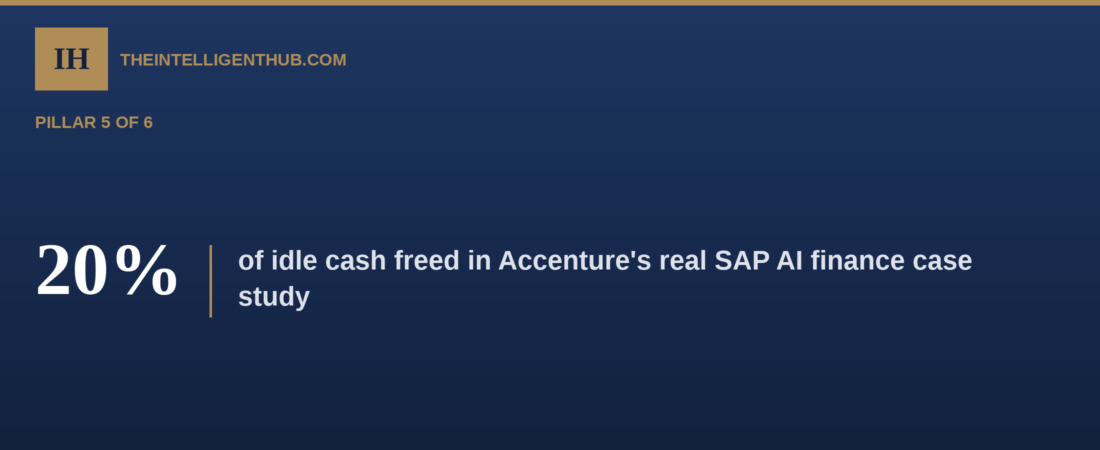
One well-documented case freed 20% of idle cash and cut a global close from five days to three. A wider look at the data shows why that result is real, why it isn’t guaranteed, and how to use case studies without fooling your own board.
In brief
- Accenture’s finance function, led by managing director Eli Lambert, used SAP’s data cloud and AI to free 20% of idle cash, more than double receivables processing automation and triple automatic receivables reconciliation (about a 300% improvement), and separately save roughly 57,000 hours a year on balance-sheet reconciliation narratives for the close, one of the most detailed, on-the-record SAP finance AI case studies published in 2026.
- That case sits inside a much less flattering aggregate picture: independent research already covered in this series found nearly 60% of SAP migrations run over budget or behind schedule, and only about a third of organizations that say they’ve deployed S/4HANA report being fully transitioned.
- A pre-AI-era analyst study (IDC, sponsored by AWS) found a 503% three-year ROI and an 11-month payback for a small sample of enterprise S/4HANA customers, useful as a floor, not a promise, given its size, sponsorship, and age.
- Named examples from utilities, IT services, and manufacturing point in the same direction as Accenture’s case: real, if less dramatic and less quantified, operational gains from SAP’s AI agents.
- The single most common mistake in using case studies for a board business case is treating a vendor-selected best case as the expected case. This article gives you a framework for telling the two apart before you build a number around one.
Why This Article Exists
The first four articles in this series made a case for what’s possible (AI agents in finance), what has to be true architecturally for it to work (clean core), what has to be true about your data (a governed foundation), and what a credible roadmap and business case look like. This article is the evidence file: real, verifiable examples of organizations doing this work, set against the aggregate numbers that show how uneven the results actually are across the wider population.
That combination matters. A single case study, read in isolation, invites a board to anchor a business case on a best-case outcome. The aggregate overrun and stagnation data from the previous article, read in isolation, invites paralysis. Put together, they give you something more useful: proof that the outcome is achievable, and an honest read on how much discipline it actually takes to get there.
The Anchor Case: How Accenture Turned Finance Into an AI Proving Ground
Accenture is a multinational professional services and IT/management consulting firm with roughly 780,000 employees across 52 countries, working with 350 partners to serve more than 9,000 clients, and it runs its own finance function on SAP. In March 2026, SAP News Center published a detailed, on-the-record interview with Eli Lambert, managing director of Finance in Accenture’s Global IT division, describing what his team achieved by applying AI to core financial processes. SAPinsider covered the same case independently the following month, and the figures in both accounts match.
Lambert’s team started with cash and liquidity. Accenture runs operational cash across more than 50 countries, a scale at which decisions tend to default to historical, manual review. His team built what they call “Intelligent Cash”: consolidating cash data from those 50-plus countries into a single data mart and applying machine learning models, inspired by how retailers manage inventory, to determine how much cash actually needs to be held at any point in time. “[AI] freed up 20% of our idle cash, which we could then move into global operations to fund acquisitions and strategic growth,” Lambert said. He also credits SAP’s data cloud, which brings SAP Datasphere, Databricks, and the team’s machine-learning workloads into one environment, with compressing modeling work that used to take months, or over a year, down to days or weeks.
Receivables were the next target. Clearing was inconsistent and reconciliation slow, because incoming payments often arrived incomplete or with partial data, a pattern most finance teams will recognize. Accenture co-developed a machine-learning-based receivables solution on the SAP platform that, in Lambert’s words, “more than doubled the automation rate for receivables processing and tripled automatic reconciliation, about a 300% improvement.” A cash application scheduler built on the same platform delivered a 7% uplift in auto-clearing, with matches produced roughly 77% faster.
The most striking result came from generative AI applied to controllership. Accenture centralized balance sheet reconciliation across more than 50 countries, then layered machine learning and generative AI on top to analyze cost categories, summarize data, and surface meaningful shifts. The resulting “Intelligent Financial Advisor” generates narrative commentaries for those reconciliations, and more than 90% are approved with little or no revision. That saved roughly 57,000 hours a year in controllership work alone, and helped Accenture move from a five-day global close to a three-day one.
Planning was the fourth area. Accenture replaced older models with SAP Analytics Cloud, applying AI-enhanced, multi-year planning models first to merger and acquisition modeling, where forecast accuracy carries real financial stakes. The result, per Lambert, was more accurate forecasts, reduced error risk, and closer collaboration between finance and business leaders on high-stakes scenarios.
Lambert’s advice to other finance leaders is a crawl-walk-run framework: start with one high-impact, data-rich function; invest early in data quality and harmonization; get the team’s cadence right before scaling; and partner closely with technology providers and system integrators who have done this before. “Use AI to spur growth,” he said. “At Accenture, we’ve been able to use AI to save significant cash in one area, which we then invest in another, high-growth process—acquisitions in our case. That’s how you use AI to really rethink your business and move it to the next level.”
What This Case Confirms From Earlier in This Series
Read against the first four articles in this series, the Accenture case isn’t a novel story so much as a confirmation, at real scale, of the mechanics this series has been describing.
- It validates the AI-agent pattern from Pillar 1: “Intelligent Cash” is functionally the same class of use case as the Cash Management Agent covered in the first article: AI reasoning over cash and liquidity data to automate decisions that used to require manual review. Seeing it deliver a specific, attributed, board-relevant number (20% of idle cash freed) at one of the largest professional services firms in the world is evidence the use case class works, not just a vendor’s roadmap slide.
- It confirms the data-fragmentation problem from Pillar 3, and its fix: Lambert’s description of modeling work compressing from months, or over a year, to days or weeks because SAP’s data cloud unifies Datasphere, Databricks, and machine-learning workloads in one place is the fragmentation problem this series quantified in Pillar 3, being solved in practice rather than in a launch announcement.
- It depends on the clean core prerequisite from Pillar 2: Lambert is explicit about this: “SAP gives us a digital core where all that transactional data is harmonized.” None of the receivables automation or reconciliation work described above is possible on a fragmented, heavily customized core. The case doesn’t mention clean core by name, but it depends on the outcome clean core is designed to produce.
- It’s what a completed business case looks like, the standard Pillar 4 argued most roadmaps don’t meet: a named finance leader who can point to specific, quantified, board-relevant metrics (idle cash freed, hours saved, days removed from the close) is exactly the evidentiary bar the previous article in this series argued most migration business cases fail to clear. This case clears it.
Signals From Other Sectors
Accenture is the richest, most rigorously documented case available for this article, but it’s a professional services company, not a manufacturer or a utility, and a single case from one sector doesn’t establish a pattern across industries. AIMultiple, an independent AI research firm, compiled a broader table of named SAP Joule customers in mid-2026, drawing on SAP’s own published case studies, blogs, and third-party sources. Three examples from that table are worth naming, with an important caveat attached: unlike the Accenture interview, these are vendor-published and self-reported, and none of them carry an independently quantified percentage the way Accenture’s results do.
- WEL Networks (utilities): running SAP S/4HANA Cloud Private Edition with Joule, reported automated invoice matching, faster asset scheduling, and broader ERP workflow automation, described as a foundation for a continuous improvement model.
- AGILITA AG (IT services): running GROW with SAP and Joule, reported faster access to SAP tools, reduced manual searches, and increased internal productivity.
- TE Connectivity (manufacturing and technology): running SAP Integrated Business Planning with Joule, reported faster scenario comparisons, accelerated planning insights, and higher-quality decisions with reduced manual effort.
Read individually, none of these three is strong enough evidence to anchor a business case on its own; they’re qualitative, vendor-selected, and unquantified. Read alongside Accenture’s case, they’re directionally consistent: real organizations across utilities, IT services, and manufacturing report the same broad category of benefit (less manual work, faster cycles, better decisions) that Accenture’s finance function documented with hard numbers. That consistency across sectors is itself a data point, even where the individual examples aren’t rigorous enough to stand alone.
The Aggregate Benchmark: What Independent Analysts Found Before the AI Wave
For a broader, more methodologically transparent number, it’s worth going back to IDC’s Business Value white paper on SAP S/4HANA on AWS, sponsored by AWS and published in August 2023. IDC conducted in-depth interviews with eight organizations (n=8) in April 2023, spanning financial services (two), automotive, consumer, healthcare, insurance, and retail, with average annual revenue of $3.19 billion and an average of 23,616 employees. IDC’s analysis found a three-year ROI of 503%, an 11-month payback period, 60% faster S/4HANA migrations and upgrades, 24% lower infrastructure costs, 29% lower three-year cost of operations, and an average of $11.19 million in annual value per interviewed organization, alongside higher revenue and productivity gains attributed to better ERP performance.
Three caveats belong next to every one of those numbers. First, the study is sponsored by AWS and measures S/4HANA specifically on AWS infrastructure, so it isn’t a vendor-neutral read on ERP modernization generally. Second, the sample is small, eight organizations, which means any single strong or weak performer can move the average meaningfully. Third, and most relevant to this series, the interviews took place in April 2023, well before the AI-agent wave covered in Pillars 1 through 3. This study measures the return on infrastructure and platform modernization, not on the AI layer Accenture’s case describes. If anything, that makes it a conservative floor: a reasonable baseline return from modernization alone, before layering AI-driven use cases of the kind documented above on top.
Reading Case Studies Without Getting Fooled by Them
This is the part of the article that matters most for how you actually use everything above. A named, on-the-record executive case like Accenture’s is a meaningfully higher standard of evidence than an anonymous vendor blog claim, but it is still one organization’s result, self-reported, and not independently audited. Before citing any case study, including this one, in a board document, three questions are worth asking explicitly.
- Who published it, and what’s their commercial interest?: Accenture’s case was published by SAP’s own news center and covered independently by SAPinsider, a trade publication, which is a stronger provenance than a single vendor blog. The AIMultiple examples are compiled from SAP’s own published materials. The IDC study was commissioned and sponsored by AWS. None of this makes the underlying numbers false, but it means every one of them carries a commercial interest in the result looking good, and should be read with that in mind.
- Is the metric self-reported, audited, or independently surveyed?: Accenture’s 20%-idle-cash and 57,000-hours figures are self-reported by a named executive on the record, a real and verifiable claim, but not independently audited the way a financial statement would be. The ISG and SAPinsider figures referenced elsewhere in this series come from independent surveys of hundreds of organizations, a different and generally more reliable category of evidence than a single case.
- What’s the starting condition of the case, versus your own?: Accenture began this work already running a large, harmonized SAP core, with the internal AI and data engineering capability of one of the world’s largest technology consultancies. An organization earlier in its clean core and data-governance journey, the subject of the second and third articles in this series, should expect a longer runway to a comparable result, not the same timeline.
None of this is an argument against using case studies. It’s an argument for using them correctly: as proof that a result is achievable and a rough sketch of the mechanism that produced it, not as a promise of what your organization will get on a comparable timeline. The aggregate numbers from the previous article in this series, close to 60% of projects running over budget or behind schedule, are the population these bright individual cases are drawn from. A board business case that only ever cites the outlier, and never the distribution it came from, is not being fully honest with the people approving the budget.
What This Means for CIOs
For CIOs building the evidence base for an AI or migration business case, five implications follow from the data above:
- Use Accenture’s four use cases as a mechanism reference, not a target: the specific pattern (a centralized data mart for cash, ML-based receivables automation, generative AI for reconciliation narratives, AI-enhanced planning) is a credible starting menu for where to look first in your own finance function, independent of whether you hit the same percentages.
- Validate that your own core is harmonized enough to support the pattern: Lambert’s results depend explicitly on a harmonized digital core. If your organization is still carrying forward significant technical debt from the pathway decisions covered in the roadmap article, budget for that work before expecting comparable receivables or reconciliation automation results.
- Treat the AIMultiple sector examples as directional corroboration, not standalone proof: they’re useful for showing a CFO or board that the benefit category shows up across industries, but they shouldn’t be the primary evidence in a business case given their qualitative, vendor-published nature.
- Size your internal targets off the aggregate benchmark, not the anchor case: the IDC study’s 503% three-year ROI, hedged appropriately for its sponsorship, sample size, and age, is a more defensible planning number than Accenture’s specific results, which reflect a much larger and more AI-mature organization.
- Build your own measurement plan before you start, not after: Accenture’s case is compelling specifically because Lambert can name exact figures. An organization that doesn’t instrument its own baseline (current idle cash levels, current reconciliation hours, current close duration) before starting won’t be able to produce the same kind of evidence a year from now, regardless of whether the underlying work succeeded.
What This Means for CFOs
For CFOs evaluating whether and how to cite case studies and benchmarks in a business case, five specific practices follow:
- Ask for the source and sponsorship of every case study before it goes in a board deck: a self-reported figure from a named executive at an independent trade publication carries more weight than an anonymous vendor claim, and a vendor-sponsored analyst study should be labeled as such, not presented as neutral research.
- Present the aggregate data alongside any anchor case, not instead of it: citing Accenture’s 20%-idle-cash result without also noting that nearly 60% of comparable projects run over budget or behind schedule, per the independent research covered in the previous article, is an incomplete picture that will eventually catch up with whoever presented it.
- Distinguish audited numbers from self-reported ones in your own reporting: when your own organization starts producing results, the same discipline applies internally: a hard, audited close-time reduction is a different category of evidence than an early, self-reported productivity estimate, and a board should be told which is which.
- Use the IDC benchmark as a floor for underwriting, not a target: a 503% three-year ROI from a small, sponsored, pre-AI-era study is a reasonable minimum bar to clear, not the number to promise the board, given everything the previous point in this article explains about its limitations.
- Fund the measurement infrastructure alongside the transformation itself: Accenture’s case is persuasive because specific metrics (idle cash, reconciliation hours, close days) were tracked from the start. Budgeting for that instrumentation is what turns your own transformation into next year’s defensible case study, rather than an anecdote nobody can quantify after the fact.
What “Good” Looks Like: A Simple Maturity Model
As with the other maturity models in this series, how an organization uses evidence, its own and others’, follows a recognizable four-stage pattern.
- Stage 1 — Borrowed confidence: the business case relies entirely on vendor-supplied case studies and benchmark claims, cited without adjustment for sponsorship, sample size, or how different the cited organization’s starting point was from your own.
- Stage 2 — Aware but uncalibrated: the organization knows to be skeptical of vendor claims in principle, but still hasn’t built its own baseline metrics, so any comparison to a case study like Accenture’s remains qualitative rather than quantified.
- Stage 3 — Benchmarked and instrumented: the organization has established its own baseline (idle cash levels, reconciliation hours, close duration, or the equivalent for its use case), sized its targets against the aggregate independent data rather than an outlier case, and can distinguish self-reported claims from audited ones in its own reporting.
- Stage 4 — A citable case in its own right: the organization can produce the same kind of specific, attributed, board-relevant figures Accenture’s case demonstrates, verified by its own internal measurement rather than borrowed from someone else’s press release.
Most organizations reading case studies like Accenture’s for the first time are somewhere in Stage 1 or Stage 2. The jump to Stage 3 doesn’t require achieving Accenture’s results. It requires building the measurement discipline that would let you know, honestly, how close you actually got.
Three Objections Worth Taking Seriously
- “Our vendor showed us a case study with even bigger numbers than Accenture’s.”: Ask the same three questions this article poses of every case study: who published it, is the figure self-reported or audited, and what was the cited organization’s starting condition. A bigger number from a less transparent source is weaker evidence, not stronger, regardless of how it’s presented in a sales deck.
- “We don’t have Accenture’s scale, so none of this applies to us.”: Scale changes the size of the opportunity, not whether the mechanism works. A smaller organization with a fraction of Accenture’s cash footprint can still apply the same class of use case (a centralized data mart, ML-based automation, generative AI reconciliation) at a proportionally smaller but still real scale. What scale does change is how long it takes to harmonize your core enough to support it, which is exactly why Pillar 2 of this series matters before Pillar 5.
- “This is all just marketing, isn’t it?”: Some of it is: the AIMultiple sector examples are vendor-published and unquantified, and the IDC study is vendor-sponsored. But Accenture’s case is a named, on-the-record executive describing specific, attributed figures, independently covered by a trade publication, which is a meaningfully different category of evidence than a marketing claim. The right response to skepticism isn’t to dismiss all of it or accept all of it; it’s to apply the three-question framework in this article to each source individually.
A Readiness Checklist
Before citing a case study or benchmark in your own business case, work through these questions:
- Have you established your own baseline for the metrics a comparable case study reports (idle cash levels, reconciliation hours, close duration, or the equivalent), so you’ll be able to measure your own result against it later?
- Have you checked who published the case study or benchmark you’re citing, and what commercial interest they have in the result looking favorable?
- Have you distinguished, in your own board materials, which figures are self-reported claims and which are independently audited or surveyed?
- Have you presented the aggregate, less flattering data (like the ISG and SAPinsider findings from the previous article in this series) alongside any anchor case, rather than citing the anchor case alone?
- Have you sized your planning targets off the broader benchmark data rather than the most impressive individual case you found?
The Bottom Line
Accenture’s case is real, well-documented, and worth taking seriously: a named finance executive, on the record, describing specific, attributed results from applying AI to cash management, receivables, reconciliation, and planning. It confirms, at meaningful scale, the mechanisms this series has described across the AI, clean core, and data trust articles. It is not, on its own, a promise of what any other organization will achieve, and it should never be presented to a board as one.
The organizations that get the most value from evidence like this are the ones that hold both halves of the picture at once: real proof that the outcome is achievable, and an honest accounting of how uneven the results are across the wider population documented in the previous article. That combination, not the anchor case alone, is what should size a business case, and what should determine how much contingency, discipline, and internal measurement infrastructure it needs.
Sources
- SAP News Center, “AI Road Map: How Accenture Uses AI as a Growth Engine” by Brenda Bown, March 31, 2026 — https://news.sap.com/2026/03/how-accenture-uses-ai-as-growth-engine/
- SAPinsider, “Turning Finance into a Growth Engine with SAP Business AI” by Chris Vavra, April 1, 2026 — https://sapinsider.org/articles/turning-finance-into-a-growth-engine-with-sap-business-ai/
- AIMultiple, “SAP AI Agents in 2026: Joule Studio case studies” by Hazal Şimşek, updated June 11, 2026 — https://aimultiple.com/sap-ai-agents
- IDC (sponsored by AWS), “The Business Value of SAP S/4HANA on AWS”, Business Value White Paper, August 2023, IDC #US51053623 — https://pages.awscloud.com/rs/112-TZM-766/images/PTNR_SAP_IDC_Whitepaper_Aug-23.pdf
Note: the Accenture figures are self-reported by a named executive in an on-the-record interview, independently covered by SAPinsider, but are not independently audited. The WEL Networks, AGILITA AG, and TE Connectivity examples are vendor-published and qualitative, compiled by AIMultiple from SAP’s own materials. The IDC study was commissioned and sponsored by AWS, covers a small sample (n=8), and was published in August 2023, before the AI-agent developments covered elsewhere in this series; it is presented here as a benchmark floor, not a current or vendor-neutral figure.
Related
Want the full picture? Explore the full series →
Evaluating your own SAP transformation program? Explore Advisory →
Have a concrete skills gap on your S/4HANA program? Explore Talent Sourcing →
Get the weekly issue
Join readers getting the next pillar drop straight to their inbox — no spam, unsubscribe anytime.