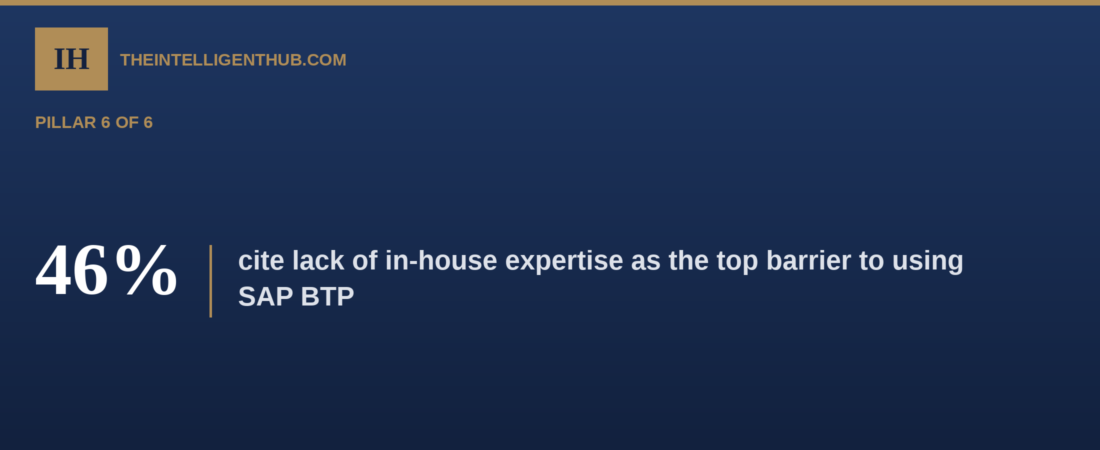
Nearly half of SAP organizations name a skills gap as their single biggest barrier to using the platform. The harder problem isn’t the shortage, it’s that the kind of skill in short supply keeps changing.
In brief
- 46% of SAP organizations cite a lack of in-house expertise as the single most significant barrier to using SAP BTP, ahead of the platform’s own complexity, according to a 2026 Precisely and ASUG survey of 173 SAP stakeholders.
- The same survey found business process change (49%), customizations (44%), and organizational resistance (37%) as the top three hurdles to S/4HANA migration, none of which a bigger project team alone solves.
- A named SAP consulting leader, interviewed in April 2026, says the shortage isn’t really about headcount: demand for pure implementation work is shrinking as AI absorbs it, while demand for people who can navigate complexity and connect technology to business outcomes is growing.
- Every pillar earlier in this series, AI agents, clean core, data governance, and the roadmap itself, depends on a specific, scarce skill set. This article maps which skills belong on which side of the build-retain-source decision.
- The organizations under the most pressure by 2027 aren’t the ones with the smallest budgets. They’re the ones still trying to source 2020-era skills for a 2026-era transformation.
Why Talent Belongs in This Series
Every article in this series so far has assumed a capable team is available to do the work: an AI-agent rollout that someone has to configure and govern, a clean core architecture that someone has to design and defend, a data platform that someone has to build and own, a roadmap that someone has to execute against a tightening deadline, and case studies that took named, credentialed people years to produce. None of that happens without the right people in the right roles, and the data below suggests that’s the constraint most business cases quietly assume away.
This article treats talent as what it actually is: not a hiring line item at the bottom of the roadmap, but a sourcing decision that has to be made deliberately for each of the specific, scarce skill sets the previous five articles in this series depend on.
The Shape of the Shortage in 2026
Precisely, in partnership with the Americas SAP Users Group (ASUG), surveyed 173 SAP stakeholders, IT leaders, business users, and transformation experts, for its 2026 benchmark report on SAP automation and modernization. The skills gap shows up as the top-ranked barrier to a specific, high-value capability: 46% of respondents cite a lack of in-house expertise as the most significant barrier to fully leveraging SAP BTP, ahead of the complexity of BTP development itself (43%) and difficulty understanding what BTP’s services can actually do (36%). That ordering matters. Organizations aren’t primarily blocked by the technology being too hard to use; they’re blocked by not having enough people who know how to use it.
The same survey found that migration itself runs into a related but distinct set of people problems. The top three hurdles to S/4HANA migration were business process change (49%), customizations that don’t transfer cleanly to a clean-core environment (44%), and organizational resistance to change (37%). None of those are solved by adding more hands to a project plan. They’re solved by people who can redesign a process, make a defensible call on which customizations to keep, and manage the human side of a large-scale operational change, exactly the more senior, more scarce skill set this article is about.
This lines up with what the previous article in this series found from a different angle: SAPinsider’s estimate of 20,000 to 25,000 SAP ERP customers still unlicensed for S/4HANA, all converging on the same 2027 deadline, and the same limited pool of qualified migration talent. A skills gap that’s already the top-cited barrier to using the platforms organizations have already bought is not going to improve on its own as that population accelerates toward the deadline.
It’s Not Just a Numbers Problem, It’s a Skills-Mix Problem
Computerwoche, part of the CIO/Foundry network, published an interview in April 2026 with Holger Scheel, managing director of cbs (Corporate Business Solutions), a German SAP consulting firm where roughly 98% of implemented solutions are SAP-based. Scheel’s read on where companies actually stand is more sober than the industry’s own marketing: “If we look at our core sectors — large and midsize industrial companies — then I would say: To put it positively, about half of the companies have started the transformation. But very few have completely finished it.” On the 2027 deadline itself, he’s direct: “Larger companies with numerous ERP systems, in particular, are unlikely to make it to extended maintenance by 2027. The 2030 timeline is a more realistic target.”
Scheel also confirms the pattern the roadmap article in this series documented independently: neither pure greenfield nor pure brownfield dominates. “The majority of companies are pursuing a hybrid approach — a selective combination of innovation and transformation. This is often called ‘smart brownfield’ or ‘mix & match.’” And critically for a talent article, he argues the work isn’t finishing when the migration does: “We’re already talking about ‘post-S/4 transformations.’ Many companies, for example, migrated to S/4HANA using a brownfield approach, without fundamentally changing their processes. This means that the real substantive transformation — innovation and further development of business processes — is still to come.”
The most important thing Scheel says, for the purposes of a sourcing decision, is about where consulting demand is actually heading, and it directly contradicts the assumption that AI simply shrinks the need for external talent: “We see very clearly that the field of consulting is not shrinking, but expanding. Complexity is increasing massively. Concepts like the ‘agentic enterprise’ add a new semantic layer. This makes IT and process landscapes even more demanding. Companies increasingly need support to understand and structure this complexity and derive meaningful business solutions from it. That is precisely where our role lies. Services that are very close to pure implementation — classic development, testing, or configuration tasks — are under greater pressure. Although this has always been the case, AI and SAP’s strategic direction will likely intensify this pressure. Such tasks will become easier to replace and will tend to be in less demand.”
Read together with the Precisely and ASUG data, the picture is consistent: the shortage isn’t evenly spread across all SAP skills. It’s concentrated in the people who can do what the earlier articles in this series actually require, judgment calls about architecture, data ownership, process redesign, and change management, while the more commoditized execution work Scheel describes is exactly what AI-assisted development and configuration tools are starting to absorb.
What “Current” Actually Means for an SAP Consultant Now
One consequence of that shift is that a credential earned once is a weaker signal of capability than it used to be. According to SAP recruiting specialists at IgniteSAP, SAP moved away from treating certification as a permanent credential starting in 2024, shifting every certification to a twelve-month validity period with a mandatory renewal assessment, and by the end of March 2026, certification exams across SAP’s portfolio had completed a move to a performance-based, open-book format, testing whether a candidate can complete a task inside a live system rather than recall a fact from a manual.
The practical implication for anyone sourcing SAP talent, whether hiring, retaining a systems integrator, or bringing in independent specialists, is that a current certificate has become a floor, not proof of currency by itself. The same recruiting specialists note that a renewal assessment can be passed without having touched a live client system in months, which means the more useful signal is recent, documented project experience on the specific capability you need, not the certificate alone.
The Sourcing Decision: Build, Retain, or Bring in Specialists
Given a shortage that’s concentrated in judgment-heavy, architecture-level skills rather than spread evenly across the SAP ecosystem, the build-retain-source decision has to be made capability by capability, not as a single blanket policy for the whole transformation.
- Build in-house where the skill is core to how the business runs day to day: the CCOE and clean core governance roles from the second article in this series, and the data ownership roles from the third, are ongoing operational responsibilities, not one-time project work. These belong inside the organization, because the judgment they require depends on institutional knowledge that a rotating cast of external consultants can’t accumulate.
- Retain a systems integrator or established consultancy for large-scope, multi-year programmes: Scheel’s own case for cbs is that complexity is the growth area, not implementation volume; the kind of firm capable of navigating a migration programme running anywhere from 18 months for a mid-market scope to 42 months for a complex enterprise one (the range documented in the roadmap article) with continuity of leadership is a different sourcing decision than staffing a single workstream.
- Bring in independent specialists for the specific, time-boxed gaps a generalist team can’t fill: a clean core extensibility assessment, a data governance design sprint, or a short, focused engagement to stand up a specific AI agent are exactly the kind of scoped, judgment-heavy work where a specialist with recent, documented experience on that exact problem outperforms a broader team spread thin across a large programme.
- Treat certification plus recent project evidence as the actual qualification bar: given that a current certificate alone is a floor rather than proof of currency, any of the three sourcing paths above should be evaluated against documented, recent work on a comparable engagement, not credentials alone.
None of these paths is inherently cheaper or safer than the others. The point of treating this as a deliberate, capability-by-capability decision, rather than a single default (usually: hire more generalists, or lean entirely on one large SI), is that it matches the sourcing model to where the actual scarcity sits, which the data above suggests is not evenly distributed.
What This Means for CIOs
For CIOs building the staffing plan behind an AI, clean core, or migration roadmap, five implications follow from the data above:
- Map your roadmap’s skill requirements before you map headcount: the Precisely and ASUG data shows the shortage concentrated in specific capabilities (BTP development, process redesign, change management) rather than generic SAP experience. A staffing plan built around generic SAP headcount will miss the actual constraint.
- Treat certification renewal cadence as a floor when evaluating any candidate or partner: given the shift to twelve-month validity and performance-based exams, ask for recent, documented project evidence on the specific capability you need, not just a current certificate.
- Assign the CCOE and data governance roles from earlier in this series to permanent staff, not rotating consultants: these are the operational judgment roles this article’s build-retain-source framework argues belong inside the organization.
- Budget for the post-S/4 transformation work, not just the migration itself: Scheel’s point about “post-S/4 transformations” means the skills demand doesn’t drop off at go-live for organizations that took a brownfield or hybrid path; if anything, the process redesign work still ahead requires more of the judgment-heavy skills that are already scarce.
- Engage specialist talent early for the narrowest, highest-judgment gaps: waiting until a generalist team hits a wall on a clean core extensibility question or a data governance design decision costs more in delay than sourcing that specific expertise up front.
What This Means for CFOs
For CFOs funding the talent side of a transformation business case, five specific practices follow:
- Price the skills-mix shift into the labor budget, not just headcount: if execution and configuration work is being commoditized while architecture and change-management judgment gets scarcer, as Scheel argues, the average cost per hour of the talent you actually need is rising even if total headcount isn’t.
- Fund the specialist-sourcing path as a distinct line item, not a contingency: targeted, time-boxed specialist engagements for specific gaps (a data governance sprint, a clean core assessment) are a planned, budgetable cost, not something to absorb informally when a generalist team gets stuck.
- Ask what happens to institutional knowledge when a large SI engagement ends: a systems integrator’s staff rotate between clients; the CCOE and governance judgment this series has argued belongs in-house should not leave with them. Budget for the transition of that knowledge explicitly.
- Treat the 2027-driven talent squeeze as a cost-timing decision, not just a scarcity problem: engaging specialist talent or a systems integrator earlier in 2026, before the full population of unlicensed ECC customers is competing for the same pool, is a cost-avoidance decision as much as a risk-avoidance one.
- Require the same evidence standard from a subcontracted specialist that you’d require from a full-time hire: recent, documented project experience on a comparable engagement, not certification alone, regardless of which of the three sourcing paths in this article you’re funding.
What “Good” Looks Like: A Simple Maturity Model
As with the other maturity models in this series, how an organization sources SAP talent follows a recognizable four-stage pattern.
- Stage 1 — Generic headcount, no skills map: staffing decisions are made against a general SAP-experience bar, without distinguishing which specific capabilities (BTP development, process redesign, data governance, change management) the roadmap actually requires.
- Stage 2 — Aware of the gap, defaulting to one sourcing path: the organization recognizes the skills shortage but addresses it with a single default response, usually hiring more generalists or expanding a single SI relationship, rather than matching each capability to build, retain, or specialist-source.
- Stage 3 — Capability-mapped sourcing: the organization has mapped its roadmap’s specific skill requirements, assigned CCOE and governance roles to permanent staff, and engages specialist talent deliberately for narrow, time-boxed gaps, evaluated against recent project evidence rather than certification alone.
- Stage 4 — Institutional knowledge retention built in: the organization has an explicit plan for what happens to knowledge and continuity when any external engagement, SI or specialist, ends, so the judgment-heavy capabilities this article describes as scarce don’t leave with the consultant who built them.
Most organizations are in Stage 1 or Stage 2: aware that SAP talent is hard to find, but still sourcing it as a single, undifferentiated problem rather than a set of distinct decisions matched to where the actual scarcity sits.
Three Objections Worth Taking Seriously
- “AI is going to shrink the need for SAP consultants anyway, so why invest in sourcing strategy now?”: Scheel’s own view, as someone running a consultancy built almost entirely on SAP work, is the opposite: execution-heavy work is shrinking, but complexity-navigation work is expanding. The sourcing decision isn’t whether to use external talent, it’s which kind.
- “We already have a systems integrator, so we don’t need a separate specialist-sourcing strategy.”: a large SI is well suited to sustained, multi-year programme delivery, but the Precisely and ASUG data shows the sharpest gaps (BTP development expertise specifically) are narrow and technical enough that a generalist SI team may not have deep bench strength in that exact area. The two sourcing paths solve different problems.
- “Certifications are a reliable enough signal; we don’t need to dig into recent project experience.”: SAP’s own move to twelve-month validity and performance-based, open-book exams reflects the same conclusion this article draws: a certificate alone no longer distinguishes someone who touched a live system last month from someone who passed a renewal assessment without doing so.
A Readiness Checklist
Before finalizing the staffing plan behind your next SAP initiative, work through these questions:
- Have you mapped your roadmap’s specific skill requirements (BTP development, process redesign, data governance, change management) rather than budgeting for generic SAP headcount?
- Are the CCOE and data governance roles from earlier in this series assigned to permanent staff, rather than left with a rotating cast of external consultants?
- Do you have a distinct, budgeted path for engaging specialist talent on narrow, time-boxed gaps, separate from your systems integrator relationship?
- Are you evaluating candidates and partners against recent, documented project evidence, not certification status alone?
- Do you have an explicit plan for retaining institutional knowledge when a large external engagement ends?
The Bottom Line
Every roadmap this series has described, AI agents in finance, a clean core architecture, a governed data platform, a credible business case, depends on a specific set of scarce skills, and the data in this article shows that scarcity is not evenly spread. It’s concentrated in judgment-heavy work: architecture decisions, process redesign, data governance, and change management, while more commoditized execution work is under real pressure from AI-assisted tools, exactly as Holger Scheel describes.
The organizations that navigate 2027 without a talent crisis are the ones treating sourcing as a capability-by-capability decision, built in-house where judgment needs to accumulate over time, retained through a systems integrator where programme continuity matters, and brought in through specialists where a narrow, scarce skill is needed for a defined period, rather than defaulting to a single sourcing model for a set of problems that don’t actually look alike.
Sources
- Precisely and ASUG, “2026 Trends in SAP Automation, Modernization, and BTP Adoption” (survey of 173 SAP stakeholders), published Nov 6, 2025, updated May 15, 2026 — https://www.precisely.com/sap-automation/2026-trends-in-sap-automation-modernization-and-btp-adoption/
- CIO / Computerwoche, “SAP 2027 deadline for S/4HANA out of reach for most customers” (interview with Holger Scheel, cbs), by Manfred Bremmer, Apr 29, 2026 — https://www.cio.com/article/4164632/the-current-hysteria-will-subside.html
- IgniteSAP, “The S/4HANA Deadline” and related SAP talent-market commentary, updated 2026 — https://ignitesap.com/the-s-4hana-deadline/
Note: the certification-policy details (twelve-month validity, performance-based open-book exams) are reported by IgniteSAP, a specialist SAP recruiting firm, and are presented here as industry commentary rather than independently verified directly against SAP’s own certification documentation. The Precisely/ASUG findings come from an independent survey conducted in partnership with a user group rather than SAP itself. The Scheel interview reflects the views of a named SAP consulting executive whose firm has a commercial interest in demand for SAP consulting remaining strong.
Related
Want the full picture? Explore the full series →
Evaluating your own SAP transformation program? Explore Advisory →
Have a concrete skills gap on your S/4HANA program? Explore Talent Sourcing →
Get the weekly issue
Join readers getting the next pillar drop straight to their inbox — no spam, unsubscribe anytime.